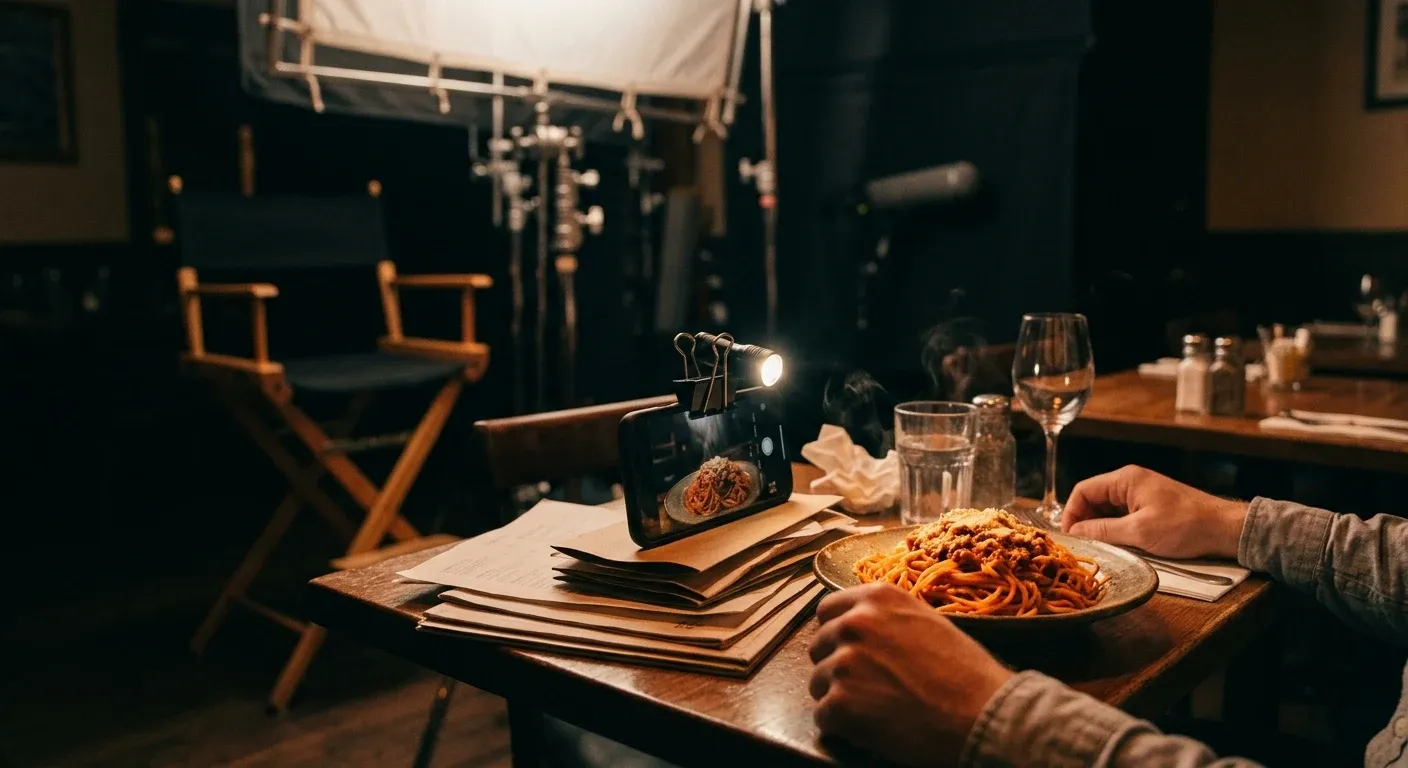
Somebody at a networking event last year asked me if I felt guilty. "You're using AI to make films," she said. "Aren't you putting people out of work?"
I didn't say what I was thinking, which was: what work?
The clients she had in mind — a local restaurant owner, a boutique hotel GM, a regional service business trying to show up on social media — were not previously hiring cinematographers, talent agencies, and post-production houses to run their Instagram. They were filming themselves on an iPhone in bad lighting and posting it at 11pm. Or they hired someone's nephew who "does social media" for $800 a month and got three videos and a ghost.
The jobs I'm supposedly eliminating don't exist. Not for this market.
The pushback on AI in creative work almost always comes from the same place: fear that the tools will hollow out the profession from the top. That studios will replace their VFX teams with a prompt. That actors will be scanned once and reused forever without consent or compensation.
That's a real conversation. It's just not mine.
What I do is different. I build content for businesses that cannot afford — and have never hired — a traditional production crew. A single day's rate for a competent DP in this market costs more than most small businesses budget for an entire month of content. A full production crew would eat through that number before you turned on a camera.
So when someone tells me AI filmmaking is stealing work, I have to ask: from whom? The restaurant on 4th Street that's been posting blurry photos of their specials since 2019? The EV charging startup that needs to pitch a landlord with a visual and doesn't have the budget for a brand film? The salon owner running her whole business solo who knows she needs better content but can't take a Tuesday off to manage a shoot?
Those clients were never in the traditional production pipeline. They're not a market I took from anyone. They're a market that didn't exist until the tools made it possible to serve them.
Here's the Number That Actually Moves People
Run the real math on what in-house content costs a small business. Not just the salary of whoever's producing it — the revision rounds, the scheduling delays, the equipment overhead, the owner's own time spent approving posts and briefing vendors. My savings calculator at arpvisuals.com puts hard numbers to all of it. Most businesses that go through it are surprised by what they find: more spend than they tracked, output they're not proud of, at a frequency that doesn't build anything.
That's not a content strategy. That's an expense account with an Instagram login.
The math on building in-house versus partnering out isn't close. But the math isn't the point. The point is whether your content is doing anything when it lands.
I Want to Be Direct About What I'm Not Saying
AI does not replace the craft of serious filmmaking. It doesn't. The work that requires a skilled director, a trained actor, a VFX team that's spent three decades figuring out how to make audiences believe something impossible — that work still requires those people. AI is not going to give a performance that earns silence in a theater. It's not going to replace the practical effects that make an action sequence feel real, or the judgment call a DP makes when the light shifts on a location you can't control.
But a local business owner who needs to show up consistently on social media four times a month? They were never going to hire that crew. The choice was never between a Hollywood production and an AI studio. The choice was between something that looks intentional and something that looks like it was thrown together at 11pm because it had to go out.
The feed stops for content that looks like someone gave a damn. That's always been true. The only thing that changed is that looking like you gave a damn no longer costs what it used to.
The real actors, the real directors, the real VFX artists — they're not losing to me. They're losing sleep over the studios, the streamers, and the contracts. That's the fight that matters for their industry.
My clients just want to stop being invisible.
